 Skip to main content
Toi et Moi Engagement Ring: Meaning & Buying Guide
Toi et Moi Engagement Ring: Meaning, History, and How to Choose
A Toi et Moi engagement ring places two stones side by side to symbolize “you and me.” Couples shopping for a two-stone design can start with that French meaning, then match stones by millimeter and seat height rather than carat alone. As of Sotheby’s reporting, the style traces to Napoleon’s 1796 gift to Joséphine—a pear diamond beside a pear sapphire.
Key Takeaways
Toi et moi is French for “you and me”: two gemstones sit side by side as equal partners, not one center stone with side supporters.
Napoleon’s 1796 ring for Joséphine—pear diamond plus pear sapphire—sold at Osenat in Fontainebleau on March 24, 2013 for about $949,000.
Match stones by face-up millimeters and seat height; carat weight alone misleads when shapes spread mass differently.
Bypass settings curve each stone into an offset seat, which can complicate a flush wedding-band stack unless the mount is planned for it.
Two smaller stones often cost less than one larger stone of similar face-up presence because price-per-carat rises with size.
A custom path lets you source both diamonds (or a diamond and colored gem), then build the mount around their real dimensions.
What is a Toi et Moi engagement ring?
A Toi et Moi engagement ring is a two-stone design in which the gems sit side by side to represent the French phrase “you and me.” Sotheby’s, Whiteflash, and Liori all define the name that way, and the side-by-side layout is the symbolic core.
Moi Moi notes that not every two-stone ring qualifies. Rings that stack stones front-to-back, nest one above the other, or treat one gem as a clear dominant center miss the equal “you and me” reading. The classic look leans toward a bypass or split shank so each stone has its own seat and visual weight.
Buyers who want that symbolism built around specific shapes and carat targets can begin with a custom engagement ring workflow: choose shapes and budget, then source each stone individually before the mount is cast or fabricated.
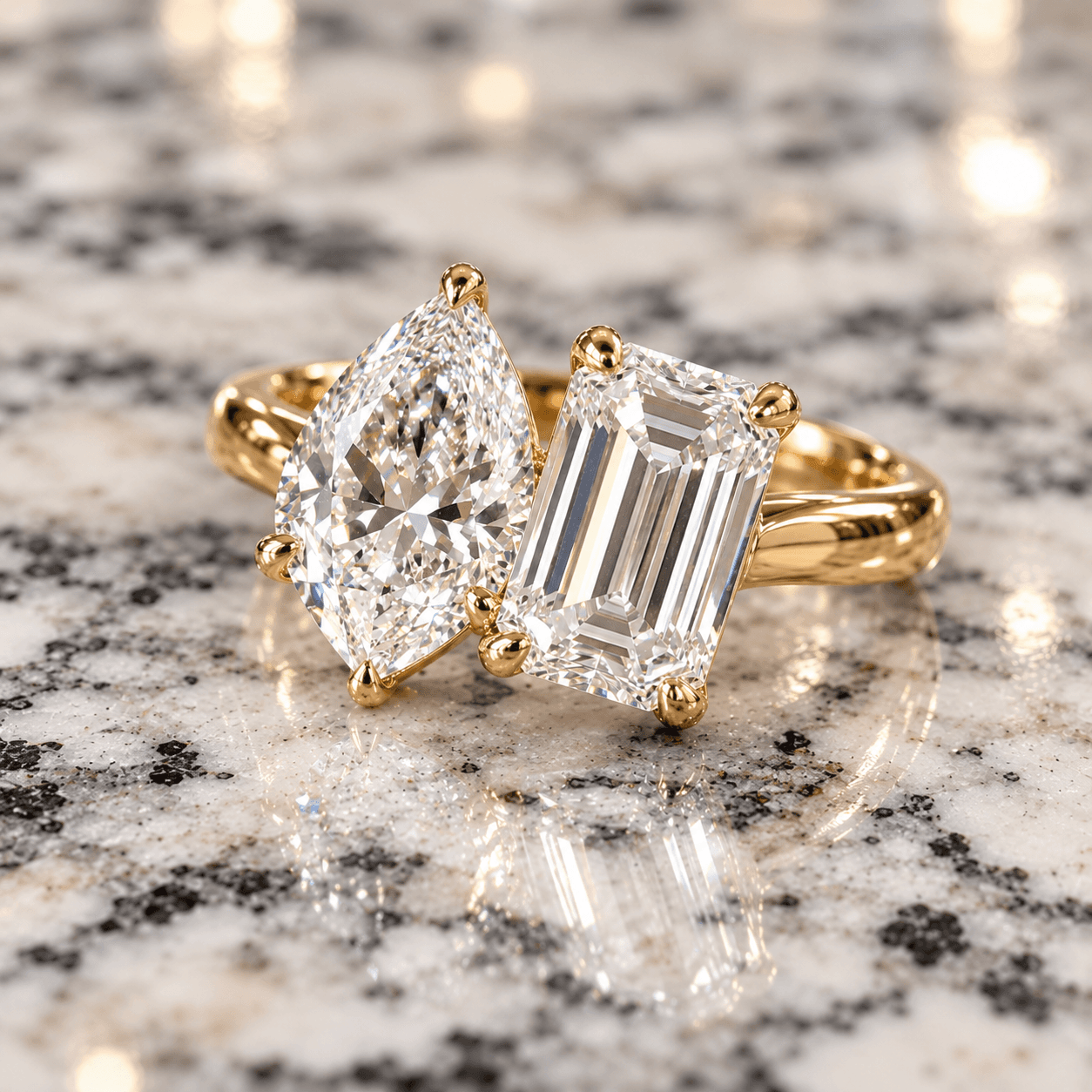
How does a Toi et Moi differ from a solitaire or three-stone ring?
A Toi et Moi engagement ring gives equal weight to two stones as partners; a solitaire centers one stone; a three-stone ring usually frames one center with two supporting side stones for “past, present, and future.” Whiteflash draws that contrast clearly: equal pairing versus hierarchy.
Style | Stone layout | Symbolism | Visual weight
|
Toi et Moi | Two stones side by side | “You and me” partnership | Balanced between both gems |
Solitaire | One center stone | Focus on a single gem | All emphasis on the center |
Three-stone | Center plus two side stones | Past, present, future | Center leads; sides support |
Shoppers comparing these styles should decide whether the ring should read as a dialogue between two gems or as a single spotlight. That choice drives pairing, setting height, and how a wedding band will sit later.
What is the history behind the Toi et Moi ring?
The modern Toi et Moi story begins in 1796, when Napoleon gave Joséphine a ring with a pear-shaped diamond and a pear-shaped sapphire set side by side. Sotheby’s, Antique Jewellers, and Osenat lot notes all record that pairing and date.
Napoleon and Joséphine married on March 9, 1796, according to Antique Jewellers and Osenat historical notes. Centuries later, that same ring sold at Osenat in Fontainebleau on March 24, 2013 for about $949,000—far above the roughly $20,000 estimate—per Gem Gossip and Antique Jewellers coverage of the auction.
Jewelry press has also linked later public figures to side-by-side designs. Moi Moi cites Jackie Kennedy’s widely reported emerald-and-diamond ring (about 2.84 ct emerald beside 2.88 ct diamond). Instore Mag (January 2023) reported Megan Fox and Machine Gun Kelly’s emerald-and-diamond birthstone Toi et Moi. Those examples show continuity of the two-stone idea; they do not set a required look for a modern commission.
Which stone pairings work best for a Toi et Moi?
The strongest Toi et Moi pairings balance face-up outline and seat height so neither stone looks like an afterthought. Liori’s pairing guidance highlights two ovals, pear with oval, two pears, round with marquise, and diamond with a colored gem as frequent combinations.
Pairing | Look and balance notes | Durability watch-outs
|
Two ovals | Soft symmetry; easy face-up match when lengths align | Protect belly contact points in the mount |
Pear + oval | Classic Napoleonic echo when the pear tip points inward or outward by design | Pear tip needs a V-prong or bezel (GIA durability guidance) |
Two pears | Strong “you and me” mirror when tips oppose or nest | Both tips need protective seats |
Round + marquise | Contrast of soft circle and elongated Navette outline | Marquise tips need V-prongs or bezels |
Diamond + colored gem | Clear partnership of colorless and hue (sapphire, ruby, emerald, pearl) | Match Mohs hardness and care needs across both stones |
GIA rates diamond at Mohs 10, sapphire and ruby (corundum) at Mohs 9, and emerald at Mohs 7.5–8 with fair-to-good toughness. Pointed diamond cuts such as pear and marquise can still chip at the tips, so GIA durability guidance calls for protective V-prongs or bezels. Emerald often carries oil or resin fillers; GIA emerald-care notes warn that ultrasonic cleaners and harsh chemicals can damage those treatments.
How should you balance carat, millimeters, and height?
Balance a Toi et Moi by matching millimeter face-up dimensions and seat height first; carat weight alone will not keep two different shapes visually even. Liori and Sotheby’s both stress that shapes spread mass differently across the table.
A 1.00 ct oval and a 1.00 ct pear can differ in length, width, and how high each girdle sits above the finger. Ask for length × width × depth in millimeters for both candidates, then compare how the setter plans the seats. If one stone sits noticeably taller, the ring can look lopsided even when carat weights match.
When total look matters more than a single large carat number, two smaller stones can deliver similar face-up presence at a lower pair cost than one larger stone of equal total weight. Engagement-ring market guides describe that pattern as price-per-carat rising with size—a general market pattern, not a store quote. Those measurements also feed the CAD when you design a Toi et Moi ring around two sourced stones rather than a single stock head.
Which settings and metals hold two stones securely?
Bypass and split-shank mounts hold Toi et Moi stones securely when each gem gets its own prong or bezel seat and the shank curves to absorb finger flex. Liori and Whiteflash describe the bypass band as a shank that splits and curves so each stone sits offset or slightly leaning toward its partner.
Shared baskets that force mismatched girdles into one plane create stress points. Independent seats let the jeweler set each stone at its own height while keeping the pair optically level from above. Pointed shapes still need tip protection regardless of metal choice.
Platinum and 14k or 18k gold all work for two-stone mounts when prong thickness and bead seats match the girdle. Soft metals need enough metal at contact points so daily wear does not thin tip prongs too quickly. Colored gems with treatments or lower toughness may favor partial bezels on vulnerable corners.
How much does a Toi et Moi engagement ring cost?
Toi et Moi cost is the sum of two stones plus a two-stone setting, so pair selection—not a single center price—drives the budget. Market benchmarks published by Whiteflash put Valoria two-stone settings under $2,000 depending on metal, while one natural 1 ct diamond can run roughly $3,000–$16,000+, meaning a matched pair of natural 1 ct stones can span about $6,000 into the tens of thousands. Lab-grown diamonds can lower the pair cost relative to natural counterparts of similar size and grade.
Those figures are published market benchmarks, not Desert Wholesale Diamond price quotes. Final cost still depends on cut quality, color, clarity, metal, and whether one stone is a colored gem with its own pricing curve.
How do you design a custom Toi et Moi ring?
Design a custom Toi et Moi by locking the two stone outlines first, then building the mount around their measured millimeters. Desert Wholesale Diamond’s custom page lets buyers pick shape, carat targets, setting style, and budget while diamonds are sourced individually—useful when both partners in the pair must match face-up size.
Choose the pairing language (two diamonds, or diamond plus colored gem) and preferred outlines.
Request millimeter dimensions and seat-height notes for both candidates before approving the CAD or hand sketch.
Confirm tip protection, bypass curve, and wedding-band clearance in the same design pass.
Approve metal and finish once the stones are secured, so the mount can be built to the actual girdles.
Couples ready to design a Toi et Moi ring can walk that sequence with a jeweler who sources each stone to fit the shared sketch rather than forcing stock stones into a fixed catalog head.
Will a wedding band fit with a Toi et Moi ring?
A wedding band will fit flush with a Toi et Moi only when the bypass curve and stone overhang are planned for stacking from the start. Offset seats and flared shanks create gaps or rocking if a straight band is added later.
Options include a contoured or curved wedding band that follows the Toi et Moi silhouette, a spacer band that fills the gap intentionally, or wearing the bands on separate fingers. Ask the designer to mock the stack in CAD or with a wax/metal sample before final casting so the engagement mount and band share one clearance plan.
FAQ
Is a Toi et Moi engagement ring only for diamonds?
No. Historical and modern examples mix diamond with sapphire, emerald, pearl, and other gems. Match hardness and care needs across both stones so daily wear does not overstress the softer partner.
Can you remount two heirloom stones into a Toi et Moi?
Yes, when both stones’ girdles and culet conditions support new seats. A jeweler measures each stone, checks for chips at tips or corners, and builds independent seats so mismatched depths still look level from above.
Does a Toi et Moi look larger than a solitaire of the same total carat?
Often the spread of two outlines covers more finger width than one round or oval of equal total weight, especially when both stones have strong length. Face-up millimeter comparison beats assuming carat totals alone.
What metal works best for a bypass Toi et Moi setting?
Platinum and 14k or 18k gold all hold bypass seats when prong mass matches the girdles. Choose metal for skin tone, alloy preference, and how often tip prongs will be inspected—not from a single “best metal” rule.
How do you clean a Toi et Moi that includes emerald?
Skip ultrasonic and steam on emerald if oil or resin fillers are present. GIA emerald-care guidance favors mild soapy water and a soft brush, then a careful rinse and dry—harsh chemicals can disturb treatments.
Plan your two-stone design with intention
A Toi et Moi engagement ring succeeds when the two stones read as partners: matched in millimeters, protected at vulnerable points, and set so a future band can coexist with the bypass curve. Start from the Napoleonic side-by-side idea, then let measured stones—not carat labels alone—drive the mount.
When you are ready to source both stones and build the setting around them, start a custom jewelry consultation with Desert Wholesale Diamond in Palm Desert, CA, or Scottsdale, AZ.